Book One · The Identity Governance Series
A working framework for defining the values that actually govern your decisions — not the ones you'd list in an interview, but the ones you fall back on when something is at stake.
Twenty years of governance, measurement and accountability — applied to a life instead of an organization.
“Standards don’t crash; they erode. They wear down slowly through tiny compromises that seem okay at the time.” — From the book
What's inside
Values That Empower walks you through naming the values that actually govern how you operate, then gives you a way to track whether you're living them — starting with the KPPI framework introduced between Part I and Part II.
Identify the three values that genuinely drive your decisions, tested against your actual behavior.
Use the KPPI Tracking Template to measure how consistently you're living each one, week to week.
Carry the framework forward into the decisions and commitments that make up the rest of the book.
Written for
Professionals already performing at a high level whose personal standards haven’t kept pace with their professional growth. People who need precision, not encouragement.
Not written for
Anyone after productivity hacks, time‑management systems or motivation. The book’s argument is that effort was never the missing piece, so it will disappoint if that is what you want.
Free resource
Referenced in the book
Enter your email and the tracker comes to your inbox — the same one the book sends you to before Part II. You’ll also be first to hear when the KPPI app and the print edition are ready.
No spam — just the tracker and launch updates. Unsubscribe anytime. See the privacy note for how your details are used.
Get the book
The ebook launches shortly, on Amazon and directly from this site. A print edition follows later this year.
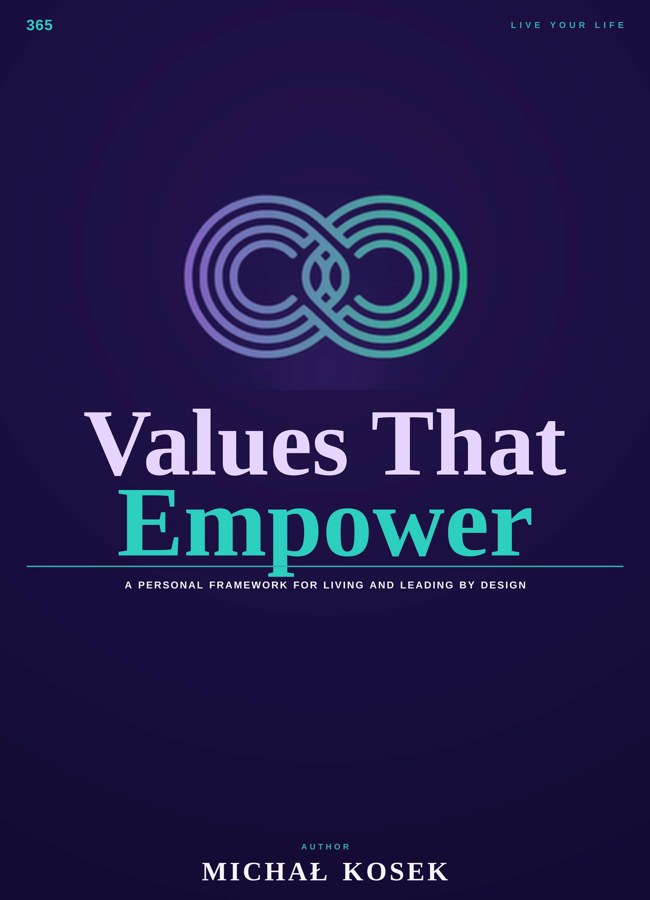
Fourteen chapters across three parts, plus an introduction, an epilogue and a reference guide. Around 34,000 words — roughly two and a half hours of reading, plus the Reflection & Application exercises that close each chapter.
Why values have to be operationalised rather than declared, how identity actually forms, why waiting for motivation is a structural failure rather than a personal one, and how to define a value precisely enough to test against your own behaviour. Part I closes on the limit of clarity: a value defined in reflection still has to survive an environment built for output.
Output: three to five core values with precise behavioural definitions.
Converting each defined value into indicators you can score daily, the Personal KPPI Menu of ten values to measure against, what to do when two legitimate values compete for the same decision, and how alignment is sustained once pressure accumulates. This is where the free tracker comes in.
Output: a working KPPI practice you can run every day.
How the same core values express differently across roles without fracturing, identity under disruption when the external structure falls away, success built on identity rather than outcome, and finally identity governance itself — living aligned by design rather than by effort.
Output: a framework that holds across roles and survives disruption.
What used to feel like a strength starts to show small, quiet cracks. Alignment rarely falls apart all at once. Instead, it wears away slowly as your standards slip under pressure, urgent emails start to override what actually matters, and you begin to mistake “staying busy” for making real progress.
From the Introduction — The System I Wish I Had
Questions
Ask before you commit.
Pick any question below and the answer appears here.
The answers are written in advance, not generated. Nothing here is a chatbot, which means nothing here can invent an answer. If your question isn’t below, email me.
No. The book is complete on its own — Chapter 7 teaches you how to turn a value into something you can score, and you could build that in a notebook. The tracker is just that method already set up in a spreadsheet, with the scoring and the monthly summaries done for you.
Fourteen chapters across three parts, plus an introduction, an epilogue and a reference guide. Around 34,000 words — roughly two and a half hours of reading. The exercises at the end of each chapter take considerably longer than the reading does.
Partly. It reads as a book, but every chapter closes with Reflection & Application exercises and a line called Your Standard that you write yourself. If you read it without doing any of that, you’ll finish with a framework you understand and haven’t installed.
Goals are destinations you arrive at and then leave. Values are standards you hold continuously, and Chapter 4 spends real time on why confusing the two is the usual failure.
The other difference is measurement. Habit apps track whether you did a thing. This tracks whether you held a standard, which is harder to define and the reason the book spends six chapters on definition before it measures anything.
The ebook launches shortly, on Amazon and directly from this site. A print edition follows later this year. Both options on this page say “Coming soon” until that happens — I’d rather say so plainly than take an order I can’t fill.
The surest way to know the day it’s live is the tracker list, which is the same list I’ll use for the launch.
You get the tracker, then occasional notes when the book, the print edition or the app are ready. That’s it. It isn’t sold, shared or rented, and every message has an unsubscribe link. The privacy note sets out exactly what’s kept and for how long.
Yes — that’s the Personal Support Program further down this page. It’s one-to-one and deliberately small. Tell me where you’re stuck and I’ll tell you honestly whether I can help.
Who wrote this
Work with me
The book gives you the method. Some people want someone in the room while they build it — particularly when the values they write down and the decisions they actually make refuse to line up.
We work through it together: defining the values foundation that holds under pressure, building KPPIs that measure something real rather than something flattering, and standing up a governance system you will still be running in six months.
This is one-to-one and deliberately small. Tell me where you are stuck and I will tell you honestly whether I can help.
Apply
Every application is read personally. There is no obligation on either side.
Prefer email? Write to 365lyl@gmail.com.
Beyond the book
Values That Empower is Book One of the identity governance series and the starting point for the wider work of 365 Live Your Life — helping individuals and organizations govern their decisions by the values they actually hold, not just the ones on the wall.
Start with the free KPPI tracker →Next: the KPPI app. The automated version of the tracker — daily scoring, monthly summaries and progress dashboards — is in development. Book Two of the series follows it. Everyone on the tracker list hears about both first, so there is nothing else to sign up for.
